The idea in one minute
AI turns inputs into predictions, suggestions or new content.
Artificial intelligence is a broad family of techniques for tasks such as recognizing speech, making recommendations or generating text. Many modern systems learn patterns from examples. Their outputs can be useful, but they are not a guarantee of truth.
Start with something familiar.
You speak and words appear on a screen. A system suggests a song. A tool proposes a draft reply to a message. These are different tasks, but each can use AI to produce an output from information it receives.
AI stands for artificial intelligence. The OECD describes AI systems in terms of the outputs they infer from inputs: predictions, content, recommendations or decisions. A chatbot is one possible form; AI also includes speech recognition and image analysis. [1]
It helps to ask what the system is doing. Is it identifying something, estimating what might happen, recommending a choice or creating a draft? That is more useful than treating AI as one tool that can do everything.
What does learning mean here?
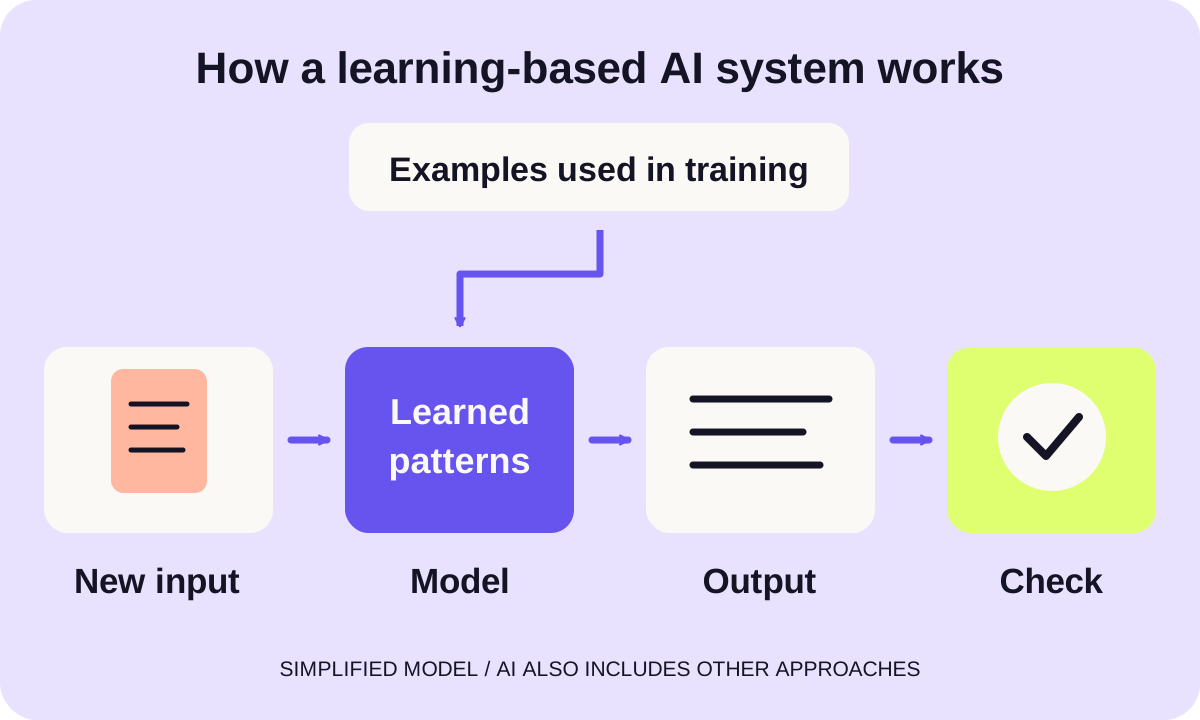
Many modern AI systems use machine learning: methods that learn patterns from data. The result is a model, which can apply those patterns to a new input. AI also includes approaches based on knowledge and reasoning; machine learning is an important part of the field, not its whole definition. [2] [1]
Imagine a system trained using messages labeled as ordinary email or spam. It can learn patterns associated with those labels, then estimate which category a new message belongs to. This is a simplified teaching example, not a description of a particular email provider.
Examples
Training data gives the system material to learn from.
Model
Training produces patterns represented in a model.
New input
The trained model processes a new message or request.
Output
It produces a result that can be checked and used.
What makes generative AI different?
Generative AI creates content such as text, images or audio. For example, instead of classifying an incoming message, it could draft a reply. The instruction you give it is often called a prompt. [3]
Think of the output as a proposed result. A fluent paragraph can contain an invented detail. NIST identifies confidently incorrect generated content as a risk. If a draft includes a price, promise or date, the person using it still needs to check those details. [3]
Where could it help a business?
Consider a small business receiving different kinds of customer messages. AI might suggest a category, summarize a long request or prepare a reply for review. The opportunity is less time spent on preparation, if checking and correcting the result does not undo the benefit.
Some jobs are better handled by predictable rules. If a form must reject a missing email address, ordinary validation is enough. AI becomes interesting when the task involves varied language, images or other information that is harder to describe with a short set of rules.
A complete digital product can combine both: normal software manages records and permissions, while AI helps with a particular task. The business value comes from a better overall result, rather than an AI label on the homepage.
A useful first experiment.
Choose a small task you understand well, such as turning a fictional customer request into a reply draft. Compare the draft with what you would write. Check what it gets right, what it misses and how much editing it needs.
This gives you a concrete way to judge potential. The question is whether the task becomes easier at a quality you can accept. Keep real sensitive information out of an initial experiment, and learn what any service does with data before sharing it.
Read further
Sources.
References checked on . Source notes explain what each reference supports.
- OECD.AI — Explaining the definition of an AI system ↗
Inputs and outputs, learning-based and knowledge-based approaches, and the distinction between training and use.
- NIST — Machine learning glossary ↗
A short definition of learning from data.
- NIST — Generative Artificial Intelligence Profile ↗
Generative content and the risk of confidently incorrect outputs. July 2024 publication.
Keep exploring